The 2026 bathroom market is moving toward private, wellness-focused spaces. Global buyers increasingly expect comfort, efficient layouts, and dependable technology.
Grand View Research identifies wellness and premium bathroom upgrades as important market drivers. Research and Markets also forecasts continued growth in home spa products through the decade. These reports suggest strong potential for the Corner Massage Bathtub, especially in compact urban homes, hotels, and residential renovation projects.
Yet market growth does not guarantee a successful purchase. A 150-centimeter bathtub may fit beautifully beside a tiled wall, but its pump, access panel, and drainage route still require careful planning. The National Kitchen & Bath Association’s recent design research emphasizes practical storage, accessibility, and personalized bathroom experiences. These priorities matter when comparing corner models across regions.
This guide reviews leading 2026 options for global buyers. It considers massage performance, water capacity, material quality, installation requirements, energy use, warranty support, and after-sales service. Regional electrical standards also deserve attention. A product designed for one market may require different protection or certification elsewhere.
The data is useful, but not perfect. Market reports often combine luxury tubs with broader bathroom products. Buyers should verify technical specifications directly with manufacturers. Look for clear pump ratings, tested materials, replacement-part availability, and installation drawings.
Details matter.
A reliable Corner Massage Bathtub should deliver quiet operation, comfortable seating, and straightforward maintenance. Price alone cannot prove quality. Real value appears after years of daily use, when seals remain secure and service remains available.
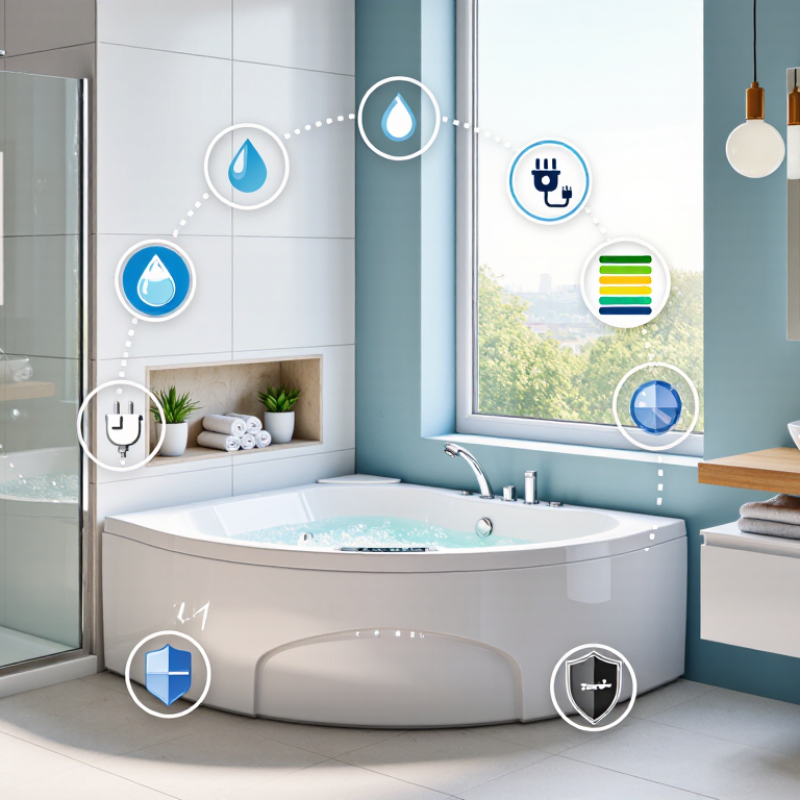
The 2026 market for corner massage bathtubs is expanding through wellness-focused housing and hospitality projects. Buyers now assess more than appearance. They examine water efficiency, installation access, pump noise, maintenance, and after-sales support.
North American buyers often prefer spacious tubs with strong hydrotherapy and easy controls. European markets place greater weight on compact dimensions, energy use, and bathroom integration. In Asia-Pacific, rising urban incomes are supporting demand for space-saving corner designs. Hotels and apartments commonly request flexible installation options. Middle Eastern buyers may prioritize premium finishes, powerful massage settings, and durable performance under demanding climate conditions. Latin American demand is developing through residential upgrades and small hospitality projects.
A practical market framework should separate buyer needs from regional assumptions. A bathtub suitable for a large Canadian home may not fit a compact European bathroom. Local plumbing standards also influence product selection. Importers should verify voltage, drainage requirements, packaging strength, and replacement-part availability before purchasing. These details are easy to overlook.
Field experience suggests that quiet operation can influence satisfaction more than extra massage modes. However, customer preferences are not uniform. Some buyers value deep soaking, while others want quick daily use. Product specifications can also appear impressive but remain difficult to compare. Clear testing data would improve trust. No framework is perfect. Climate, housing design, installer skill, and consumer habits can change the final decision. Global buyers should therefore combine regional research with direct product evaluation and realistic installation trials.
A neutral, brand-free planning framework for corner massage bathtub buyers, importers, hospitality developers, bathroom distributors and residential renovation projects. Regional indicators use the latest broadly comparable public data available and should be validated against country-level sales, import and construction records before commercial forecasting.
| Dimension | Market Segment or Indicator | 2026 Buyer Relevance | Recommended Evaluation Metrics | Growth Signal |
|---|---|---|---|---|
| Primary product format | Corner whirlpool or massage bathtub designed for two-wall installation | Uses bathroom corners efficiently and can provide a larger bathing area than many rectangular formats. | Overall footprint, bathing well dimensions, water capacity, installation clearance, access-panel requirements and floor-load suitability. | High |
| Hydrotherapy configuration | Water jets, air jets or combined air-and-water systems | Buyers increasingly compare massage intensity, noise, cleaning performance and control simplicity rather than jet count alone. | Jet layout, pump output, operating noise, independent zone control, dry-run protection and service accessibility. | High |
| Residential replacement | Bathroom renovation, aging-in-place improvement and premium home wellness | Replacement projects generally favor installation compatibility, reliability, easy cleaning and after-sales service. | Fit with existing plumbing, electrical requirements, delivery access, warranty terms, spare-parts availability and maintenance time. | High |
| New residential construction | New apartments, detached housing and higher-specification bathrooms | Demand depends on housing completions, bathroom floor area, developer specifications and local water and electrical codes. | Developer-approved specifications, standardized installation drawings, batch consistency, packaging protection and lead time. | Medium |
| Hospitality and wellness projects | Hotels, serviced apartments, resorts, spas and private wellness suites | Commercial buyers prioritize cleaning procedures, downtime reduction, safety documentation and lifecycle cost. | Commercial-use suitability, disinfection procedure, replaceable components, water management, noise level and service response. | High |
| Accessibility and safety | Low-entry access, stable seating, grab-bar compatibility and slip-resistant surfaces | Safety features can expand suitability for older users and accessible accommodation, but they must comply with local building requirements. | Entry height, internal seat position, transfer space, slip-resistance information, emergency access and user controls. | High |
| Water and energy performance | Lower-fill operation, efficient pump control and reduced heat loss | Operating cost and sustainability are increasingly important where water, electricity or hot-water capacity is constrained. | Published fill volume, pump power, heating method, insulation, standby consumption and local water-heating compatibility. | High |
| Smart-home integration | Digital controls, lighting, timed programs and remote monitoring | Useful mainly in premium residential and hospitality projects; reliability and manual override are more important than connectivity alone. | Control-interface stability, offline operation, electrical safety, software support, privacy policy and replacement cost. | Selective |
| Installation and compliance | Electrical protection, plumbing connection, ventilation, structural support and product documentation | Compliance risk can delay projects even when product demand is strong. | Local electrical certification, residual-current protection requirements, plumbing instructions, installation drawings and technical files. | High |
| Channel strategy | Bathroom distributors, specialist installers, project procurement, e-commerce and direct renovation sales | Large and heavy products require strong logistics, installation support and clear damage-claim procedures. | Carton dimensions, damage rate, minimum order quantity, landed cost, installer network and return handling. | Medium |
| Buyer Region | Urbanization Context | Electricity-Access Context | Most Relevant Buyer Groups | Key Demand Drivers | Primary Barriers | 2026 Opportunity Signal |
|---|---|---|---|---|---|---|
| North America | Highly urbanized; approximately four-fifths of the population lives in urban areas according to World Bank regional indicators. | Near-universal electricity access supports electrically powered hydrotherapy equipment, subject to local code compliance. | Renovation contractors, premium homeowners, accessible-housing projects, hotels and wellness properties. | Large bathroom-remodeling market, home wellness, replacement demand, aging population and preference for comfort features. | High freight volume, installer expectations, product-liability exposure and strict electrical requirements. | High |
| Europe | Highly urbanized, with substantial demand concentrated in established cities and mature housing stock. | Electricity access is broadly universal, but national installation rules and conformity documentation remain important. | Bathroom showrooms, renovation specialists, hospitality groups, accessible-living developers and wellness facilities. | Bathroom refurbishment, water-efficiency awareness, aging-in-place demand, compact urban layouts and sustainability requirements. | Multiple national languages, product-conformity obligations, older-building access constraints and high energy-cost sensitivity. | High |
| East Asia and Pacific | Urbanization is above the global average and continues to support apartment, hotel and mixed-use development in many markets. | Electricity access is high overall, although voltage, plug, circuit and building requirements differ by country. | New residential developers, urban apartment buyers, hotels, spas and premium bathroom distributors. | Urban housing development, compact-space product design, hospitality investment, premium remodeling and wellness lifestyles. | Apartment size limitations, differing electrical standards, price competition and complex last-mile delivery. | High |
| Middle East and North Africa | Urbanization is high in many Gulf and North African markets, with demand concentrated in major cities and tourism centers. | Electricity access is high in most urban Gulf markets, while regional performance varies across the wider area. | Luxury residences, hotels, resorts, private villas, spas and property developers. | Luxury construction, hotel and resort development, private wellness spaces and high-specification bathroom fit-outs. | Water scarcity, hot-climate logistics, project-based procurement, local certification and service-part availability. | High |
| Latin America and the Caribbean | One of the world's most urbanized developing regions, with demand concentrated in metropolitan housing and tourism markets. | Electricity access is high overall, but reliability, voltage and local installation practices vary by country. | Urban renovation buyers, hotels, resorts, residential developers and specialty bathroom retailers. | Residential remodeling, hospitality construction, premium apartment projects and improving consumer interest in home wellness. | Import duties, currency volatility, freight cost, installer availability and uneven after-sales coverage. | Medium–High |
| South Asia | Urbanization remains lower than in the most developed regions but is increasing as cities expand and housing construction grows. | Electricity access has improved substantially, although reliability and service quality can differ between urban and rural areas. | Hotels, resorts, luxury residences, real-estate developers and upper-middle-income renovation buyers. | Urban population growth, hospitality investment, premium housing and expanding bathroom-modernization demand. | Price sensitivity, water availability, building-service limitations, local installation skills and import costs. | Medium–High |
| Sub-Saharan Africa | Urbanization is rising rapidly from a lower base, creating long-term potential in major cities and tourism corridors. | Electricity access is improving but remains uneven across countries, making power reliability a key product consideration. | Hotels, resorts, high-end residential projects, property developers and urban wellness facilities. | City growth, tourism construction, premium housing and new hospitality capacity. | Power reliability, water supply, financing, logistics, technical service coverage and imported-product costs. | Selective |
| Evaluation Area | Suggested Weight | What Buyers Should Verify | Typical Risk if Not Verified |
|---|---|---|---|
| Safety and regulatory compliance | 20% | Electrical protection, applicable national standards, installation instructions, safety warnings and conformity documents. | Project delays, installation rejection, safety incidents or insurance complications. |
| Installation compatibility | 18% | Footprint, access route, drain position, hot-water connection, circuit rating, ventilation and floor support. | Unexpected construction work, failed delivery or costly reinstallation. |
| Product performance | 17% | Jet performance, pump noise, filling and draining behavior, temperature control and control-panel usability. | Low customer satisfaction and high return or service rates. |
| Hygiene and maintenance | 15% | Drainability, pipe cleaning procedure, accessible service parts, surface cleaning and mold-resistance measures. | Odor, biofilm, maintenance complaints and premature component replacement. |
| Delivered cost and logistics | 12% | Product price, freight, insurance, duties, packaging dimensions, damage claims and installation labor. | Margin erosion and delivery-related disputes. |
| Durability and serviceability | 10% | Material specification, pump and heater replacement process, warranty conditions and technical support. | Long downtime and poor lifecycle economics. |
| Water and energy efficiency | 8% | Fill volume, pump power, heating energy, insulation, standby consumption and local resource constraints. | Higher operating costs and weaker sustainability performance. |
Six to twelve jets are common. Six well-positioned jets can balance pressure around the back and hips. More jets do not guarantee better massage. Jet angle matters.
Check both rated flow and working flow in litres per minute. Plumbing bends, filters, and openings can reduce actual performance. Compare flow, noise, and control settings together. A stronger pump may feel unpleasant.
This capacity suits many compact corner spaces. Usable bathing volume will be lower than the listed capacity. Water, the shell, and the user create substantial floor weight. Confirm the floor load before installation.
Confirm drainage, access-panel space, electrical requirements, and local installation rules. Leave room around the pump. A tight corner can make repairs difficult. That is easy to overlook.
Fill the bathtub and test every jet. Check uneven pressure, vibration, slow drainage, and fitting leaks. Do not rely only on display controls. Test it physically.
Use a dedicated circuit with ground-fault protection installed by a qualified electrician. Confirm the operating voltage before importing. Check whether the plug and protection arrangement meet local rules. Electrical safety involves more than one device.
Request current electrical and mechanical safety test reports. Ask for a conformity declaration matching the exact model. Generic paperwork may not prove identical construction. I would verify the model number carefully.
No. Certification supports compliance with applicable safety rules. It does not replace a physical inspection. Check temperature control, slip resistance, pump sealing, and accessible controls. Paperwork is not enough.
The 2026 market for Corner Massage Bathtub products is shaped by growing demand for compact wellness solutions in residential and hospitality spaces worldwide. Global buyers should evaluate regional preferences, installation conditions, and long-term operating costs before selecting a model. A common corner configuration is approximately 60 × 60 inches, while allowing at least 30 inches of clear access can improve entry, maintenance, and user comfort. Buyers should also confirm room dimensions, plumbing locations, electrical requirements, and floor-load capacity before ordering.
A reliable unit typically offers 6–12 hydrotherapy jets, balanced pump flow, and a water capacity of about 150–200 liters, depending on the design. Safety remains essential: product documentation should address applicable requirements such as UL 1795, EN 12764, CE marking, and GFCI protection where relevant. For global sourcing, inspect acrylic thickness and finish, request ISO 9001 quality-system information, compare warranty coverage, and verify the availability of replacement pumps, jets, controls, and other service parts. These checks help buyers choose a durable, compliant, and serviceable bathtub for different markets.

 Kaifeng