China’s Chrome Sliding Shower Doors suppliers are gaining attention as bathroom renovation demand favors clean lines, compact layouts, and durable metal finishes. Houzz’s 2024 U.S. Bathroom Trends Study reports continued investment in upgraded showers, especially in primary bathrooms. The NKBA 2024 Design Trends Report also identifies wellness, storage, and accessible bathroom planning as strong design priorities. These trends create practical opportunities for Chinese manufacturers.
A reliable supplier should offer more than a mirror-like finish. Buyers should inspect 6–8 mm tempered glass, stainless-steel rollers, corrosion-resistant hardware, and smooth track movement. Hard-water regions need extra attention. Mineral deposits can expose weak plating quickly. Grand View Research’s bathroom fixtures market analysis also points to steady global demand, but market growth does not guarantee consistent factory quality.
Details matter.
Renovation expert Mike Holmes often says, “Make it right.” That simple principle fits Chrome Sliding Shower Doors. The door should close evenly, drain safely, and remain stable after repeated use. Suppliers should provide factory inspection records, coating tests, glass certifications, packaging photos, and clear warranty terms. Factory audits and sample approval can reveal problems before shipment.
Still, no supplier is perfect. Even polished catalog images can hide rough rollers, thin chrome layers, or poor installation instructions. That is why this guide compares China’s leading suppliers through materials, production experience, customization ability, testing practices, and after-sales support. The strongest partners may not offer the lowest quotation. They offer fewer surprises.
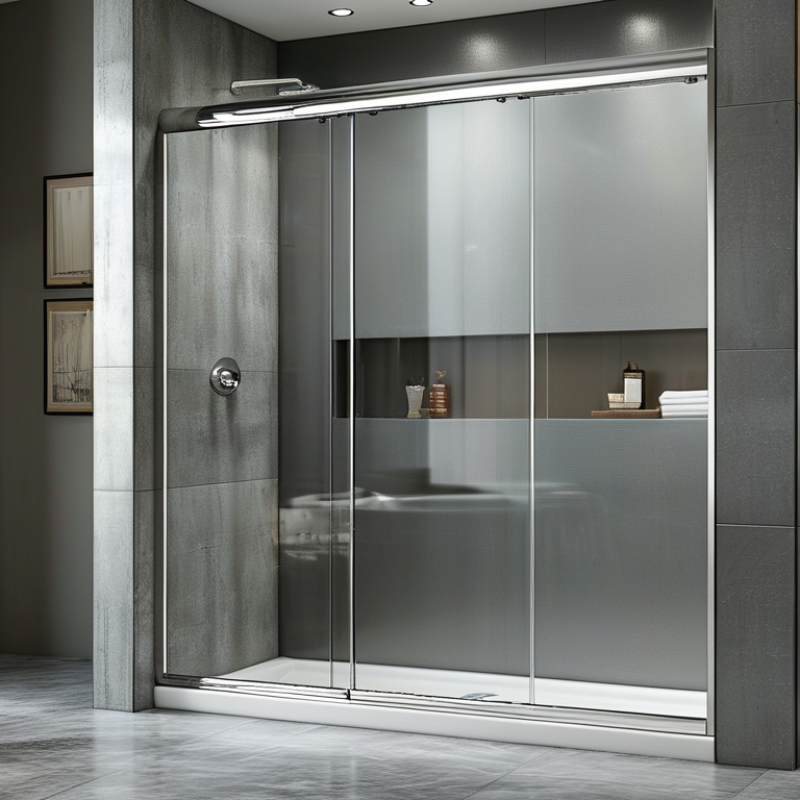
China’s chrome sliding shower door sector is supported by a large bathroom manufacturing network. Fortune Business Insights reported that the global shower enclosure market was valued at approximately USD 3.6 billion in 2023. Asia-Pacific remains a major production and consumption region. This creates strong sourcing opportunities, but supplier quality varies sharply.
Experienced Chinese suppliers typically offer 6–10 mm tempered glass, chrome-plated aluminum frames, and stainless-steel rollers. In factory audits, buyers should inspect frame thickness, plating uniformity, glass edge finishing, and roller movement. A door may look polished under showroom lights. Poor alignment appears after repeated use. It is a small detail.
Market research from Grand View Research identifies renovation activity and compact bathroom design as important demand drivers. Suppliers serving overseas projects increasingly provide custom widths, soft-close systems, and corrosion-resistant finishes. However, chrome performance depends on cleaning chemicals, humidity, and coating preparation. Catalog claims alone are not enough.
A reliable sourcing process should request test records, installation drawings, carton drop-test evidence, and samples from current production. Ask for measured tolerances, not general promises. EN 12150 and related safety requirements can guide tempered-glass verification, while local building rules still require review. Industry reports provide useful direction, but their figures are not a purchase guarantee. I would also compare three samples before approving a container order.
A high-quality chrome sliding shower door should feel precise before it looks attractive. In installation checks, I examine the frame joints, glass edges, and roller movement. The chrome surface should appear even, without cloudy patches or sharp finishing marks. It also needs resistance to daily moisture, soap residue, and repeated cleaning.
Tempered safety glass is essential. A suitable thickness improves stability and reduces vibration during use. Smooth rollers should guide the panels quietly, without scraping the lower track. Adjustable wheels help correct minor wall differences, which are common in real bathrooms. This feature saves time during fitting. However, adjustment cannot fix poor measurements.
Reliable seals matter just as much as the visible frame. Flexible strips should close firmly against the glass and remain stable after frequent opening. A slightly raised threshold can direct water back into the shower area. Drainage still depends on the floor slope. That detail is often overlooked.
From practical quality reviews, I also check the hardware structure beneath the chrome finish. Stainless components, secure fasteners, and clear installation instructions support long-term performance. Easy-clean surfaces reduce maintenance, but they are not maintenance-free. Hard water can still leave marks. Regular drying with a soft cloth helps preserve the finish. I would not judge a supplier by appearance alone. Consistent dimensions, careful packaging, replacement parts, and responsive technical support reveal greater reliability. Small imperfections can happen, but they should be identified and corrected before delivery.
China Best Chrome Sliding Shower Doors Suppliers
A reliable Chinese shower door manufacturer should be evaluated beyond polished photographs and low quotations. Request factory videos, production records, and a recent sample. Check the frame’s material, chrome thickness, glass edges, roller design, and adjustment range. Small details matter.
During a sample review, measure the door gap with a ruler and inspect movement after repeated opening. The door should slide smoothly without scraping or excessive noise. Ask whether tempered glass testing is performed by an independent laboratory. Verify the report number, testing scope, and production date. Certificates alone do not prove consistent quality.
I once focused too heavily on finish and ignored packaging strength. That was a costly lesson. Ask the manufacturer to show carton tests, corner protection, and loading photos. Confirm inspection procedures for every batch, not only the first sample. A capable supplier can explain tolerances clearly and provide replacement parts quickly. Communication is evidence. If answers remain vague, pause the order. Visit the facility when possible, or hire an experienced third-party auditor. Evaluate production capacity, worker training, complaint handling, and documentation together. The cheapest offer may not be the best value.
China Best Chrome Sliding Shower Doors Suppliers should prove more than attractive catalog photos. Production standards begin with certified tempered safety glass, stable rollers, and corrosion-resistant chrome plating. ANSI Z97.1 and CPSC 16 CFR 1201 are useful references for glass safety testing. Chrome surfaces should also follow recognized plating practices, such as ASTM B456 and ISO 1456.
Grand View Research estimated the global bathroom fixtures market at about USD 132 billion in 2023, with continued growth expected through 2030.
That pressure can encourage faster production. It can also weaken inspection. Reliable suppliers should use incoming-material checks, glass edge inspection, coating-thickness testing, and repeated door-cycle tests. Ask for batch records, not only a general certificate. A perfect sample proves little. I have seen small roller misalignments create noise, drag, and uneven gaps after installation.
Tips: Request test reports dated within the current production period. Confirm glass thickness, alloy grade, plating method, load capacity, and replacement-part availability. Check whether the supplier records failed units. That detail matters. A factory that admits defects may control them better than one claiming zero defects. Packaging also deserves inspection, because chipped corners often appear after transport, not during assembly.
China Best Chrome Sliding Shower Doors Suppliers
Supplier selection should begin with measurable production evidence, not polished catalog photos. Grand View Research estimates the global shower doors market at roughly USD 3 billion in 2023, with continued growth expected through 2030. This demand attracts many trading companies. Ask for factory audit records, glass thickness, hardware test results, and recent export references. For chrome sliding doors, inspect 6–8 mm tempered glass, roller smoothness, drainage clearance, and coating consistency under bright light. A small sample room helps.
Customization requires disciplined drawings. Confirm opening width, glass height, chrome tone, handle position, roller type, packaging size, and replacement parts. Suppliers should provide CAD drawings and pre-production samples before mass manufacturing. Request testing against applicable standards, such as ANSI Z97.1, EN 12150, or local equivalents. Standards differ by destination. That detail is often missed.
Export planning needs equal attention. UNCTAD reports that maritime transport carries over 80% of global merchandise trade by volume, so container scheduling matters. A supplier should calculate carton dimensions, pallet loading, moisture protection, and damage allowances. Use reinforced corner guards and separated glass panels. Clarify Incoterms, inspection timing, spare-part ratios, and claims procedures in writing. Chrome can appear flawless before shipping, yet fail after humidity exposure. I have seen packaging treated as an afterthought; that assumption deserves reconsideration. Reliable suppliers accept pre-shipment inspection and share corrective-action records, even when the order is small.
| Evaluation Dimension | Recommended Specification or Benchmark | Customization Options | Supplier Verification Points | Export Considerations | Planning Note |
|---|---|---|---|---|---|
| Product Structure | Two-panel or three-panel sliding configuration with a corrosion-resistant chrome-finished frame and adjustable rollers. | Panel quantity, opening direction, frame profile, handle style, guide rail design, and threshold configuration. | Request engineering drawings, section views, assembly instructions, and confirmation of load-bearing points. | Confirm whether the packed dimensions fit the intended container and whether the product requires upright shipping. | Use drawings rather than product photographs for final approval. |
| Glass Safety | Tempered safety glass is commonly specified in 6 mm or 8 mm thickness for framed sliding shower doors. | Clear, frosted, patterned, tinted, or digitally treated glass; edge treatment and protective film can also be specified. | Check the glass thickness, tempering process, fragmentation performance, flatness, and applicable test reports. | Verify destination-market requirements for safety glazing, labeling, and documentation before production. | Tempered glass should not be cut or drilled after tempering. |
| Chrome Finish | Uniform bright chrome appearance with consistent coverage on visible aluminum or metal surfaces. | Bright chrome, brushed chrome, satin finishes, coating thickness, gloss level, and anti-fingerprint treatment. | Ask for finish samples, color approval procedures, adhesion testing, and corrosion-resistance test results. | Protect finished surfaces with individual wrapping and moisture-resistant packaging during sea transport. | Approve a physical sample when appearance consistency is important. |
| Hardware Durability | Rollers should move smoothly and support repeated opening and closing without excessive noise or derailment. | Single or double rollers, stainless-steel or plated hardware, soft-close mechanisms, and replacement wheel kits. | Review cycle-test results, roller adjustment range, spare-parts availability, and installation tolerances. | Include spare rollers, seals, screws, and installation tools in the packing list when required. | A replaceable roller system can reduce after-sales service costs. |
| Size and Fit | Common retail sizes include widths around 1,200–1,800 mm and heights around 1,800–2,000 mm; actual sizes vary by market. | Made-to-measure width and height, wall adjustment range, corner installation, alcove installation, and non-standard openings. | Confirm finished dimensions, allowable wall deviation, installation clearance, and compatibility with the shower tray. | Use metric dimensions consistently and confirm whether local installation teams require imperial conversions. | Site measurements should be completed before custom production. |
| Water Management | Vertical seals, bottom guides, magnetic or overlapping seals, and a properly aligned threshold should limit water leakage. | Seal profile, seal hardness, magnetic strip strength, threshold height, drainage direction, and splash-guard design. | Request water-spray test procedures, seal replacement information, and installation instructions for leveling. | Keep seals flat or suitably protected in cartons to prevent permanent deformation during transport. | Leak resistance depends on both product design and installation quality. |
| Quality Control | Finished products should be checked for glass damage, frame alignment, finish defects, missing parts, and smooth operation. | Pre-shipment inspection plan, inspection frequency, carton markings, barcode labels, and inspection photographs. | Define acceptance criteria for dimensions, appearance, hardware function, packaging, and quantity before placing an order. | Consider third-party inspection before shipment for large or customized orders. | Use an approved sample as the visual and functional reference. |
| Packaging Design | Individual glass protection, corner guards, foam separators, reinforced cartons, and moisture-resistant outer protection. | Export cartons, wooden cases where permitted, palletization, printed labels, drop-test requirements, and retail packaging. | Check carton strength, internal movement, glass separation, packing-list accuracy, and package dimensions. | Confirm compliance with destination rules for wood packaging if wooden pallets or crates are used. | Packaging should be validated using the final product configuration. |
| Order Quantity and Lead Time | Stock items usually require less preparation than customized sizes, finishes, or packaging. | Trial order quantity, mixed-size loading, private-label packaging without displaying brand information, and phased production. | Confirm minimum order quantity, sample lead time, production schedule, capacity during peak seasons, and late-delivery procedures. | Allow additional time for inspection, export documentation, port handling, and international transit. | Lead times should be written into the purchase agreement. |
| Trade Terms and Cost | Compare product price together with packaging, inland transport, documentation, inspection, freight, insurance, duties, and local delivery. | Quotation by finish, glass thickness, size, packaging type, order quantity, and delivery term. | Request a clearly itemized quotation and confirm the validity period, payment schedule, tooling charges, and warranty terms. | Compare EXW, FOB, and CIF or other agreed Incoterms only after confirming the named place or port. | The lowest unit price may not be the lowest landed cost. |
| Documentation | Commercial invoice, packing list, transport document, product specification, and origin information are typically required for export clearance. | Document language, carton labels, installation manuals, inspection records, and destination-specific declarations. | Check that quantities, weights, dimensions, product descriptions, and consignee details match across all documents. | Confirm import requirements, tariff classification with a customs professional, and any local certification obligations. | Documentation requirements vary by destination and shipment method. |
| After-Sales Support | Support should cover installation guidance, replacement seals, rollers, handles, screws, and damage-claim procedures. | Spare-parts packages, multilingual manuals, technical videos, installation diagrams, and warranty duration. | Evaluate response times, replacement-part pricing, claim evidence requirements, and responsibility for transit damage. | Keep a small spare-parts inventory in the destination market when installation volume is high. | Clear service terms reduce disputes after delivery. |
| Use of benchmarks: Dimensions, glass thicknesses, lead times, and packaging methods shown above are practical planning references rather than universal requirements. Final specifications should be confirmed against the destination market, applicable building and safety regulations, approved drawings, and the signed purchase agreement. | |||||
China offers a broad manufacturing network, flexible customization, and competitive production capacity. Many suppliers provide tempered glass, metal frames, and sliding hardware. Quality still varies sharply.
Common options include 6–10 mm tempered glass. Ask for measured thickness, edge-finishing details, and safety test records. Do not rely on catalog photographs alone.
Check frame thickness, chrome coating uniformity, glass edges, roller movement, and panel alignment. Test the door repeatedly. A smooth showroom sample may become noisy later.
Confirm opening width, glass height, handle position, frame finish, roller type, and replacement parts. Request technical drawings and a pre-production sample. Small details matter.
Inspect coating preparation and surface consistency under bright light. Ask about humidity and cleaning-chemical resistance. Chrome may look flawless initially, but moisture can reveal weak preparation.
Request factory audit records, glass test results, installation drawings, packaging tests, and recent export references. Measured tolerances are more useful than general promises. Some suppliers may hesitate.
Review carton dimensions, pallet loading, moisture protection, and damage allowances. Use reinforced corner guards and separate glass panels. Packaging is not a minor issue.
Clarify delivery terms, inspection timing, spare-part quantities, and claims procedures. Require pre-shipment inspection and corrective-action records. Agree on these details before production.
Yes. Compare at least three samples for alignment, roller noise, coating appearance, drainage clearance, and packaging strength. I would not approve a large shipment from one sample only.
China has become a significant manufacturing hub for Chrome Sliding Shower Doors, offering a broad range of designs, materials, and customization options for international buyers. High-quality products typically feature corrosion-resistant chrome finishes, durable tempered glass, smooth sliding systems, secure seals, and precise hardware construction. These features improve safety, appearance, longevity, and user comfort in different bathroom environments.
When evaluating Chinese suppliers, buyers should examine production capabilities, technical expertise, quality-control procedures, certifications, and communication efficiency. Attention should also be given to the materials used, glass thickness, surface treatment, packaging protection, and inspection standards. Reliable suppliers should support customized dimensions, glass styles, hardware finishes, and installation requirements while providing clear samples and documentation. Export considerations, including lead times, shipping arrangements, packaging, after-sales service, and compliance with destination-market requirements, are equally important. A careful comparison of quality, pricing, customization capacity, and service can help buyers establish stable and successful supplier relationships.

Kaifeng