An Oval Bathtub is a tub with a rounded, elliptical outline, usually without the sharp corners of a rectangular model. Its shape can soften a bathroom’s appearance and make the bathing area feel more sculptural. But “oval” describes the silhouette, not the soaking depth, capacity, or comfort. Those details vary by model. Check them closely.
The National Kitchen & Bath Association’s 2024 Kitchen & Bath Design Trends Report highlights wellness and spa-inspired features as important bathroom design themes. An oval tub can support that look, especially when paired with warm lighting, calm finishes, and clear floor space. Yet the room’s measurements matter more than a showroom photograph. Measure the tub’s full rim, faucet clearance, doorway, and route into the bathroom before choosing one. A broad oval may look inviting but leave little room to move.
Water use deserves a practical check, too. The U.S. Environmental Protection Agency’s WaterSense program sets a 2.0-gallon-per-minute limit for labeled showerheads, compared with the federal standard of 2.5 gallons per minute for conventional models. That figure does not predict a bathtub’s water use; tub capacity and fill level do. Ask manufacturers for capacity and interior dimensions, then compare them with your household’s needs. The shape is appealing. Fit is less forgiving.
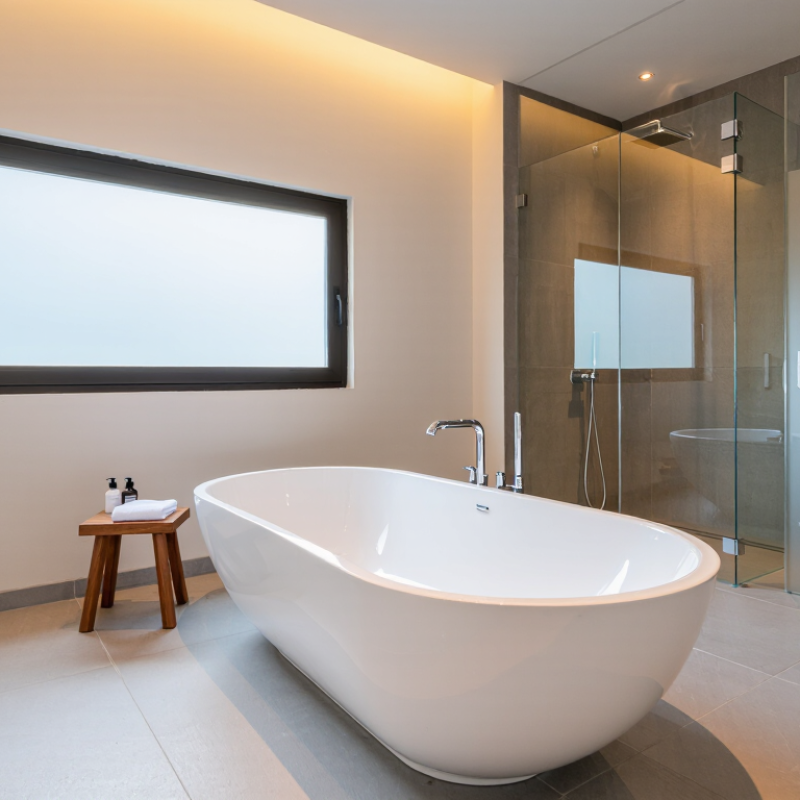
An oval bathtub has a rounded, elongated basin without the sharp interior corners of a rectangular tub. Its curved outline can soften a bathroom’s appearance, while the sloped sides often allow a comfortable reclined position. Some models stand freely; others fit into a built-in surround. The shape alone does not guarantee comfort, though. Check the basin’s usable length and depth, not just its outer dimensions.
Material and installation affect everyday use. Acrylic tubs are relatively light, while cast iron models are much heavier and may need extra floor-support checks. Oval tubs can also require more floor area than their smooth outline suggests. Measure the room, doorway, and route into the bathroom before ordering. The U.S. EPA’s WaterSense bath-and-shower guidance notes that a full bathtub may hold about 70 gallons. That matters. A deeper oval model may need more water, so consider household water use alongside comfort.
Tips: Sit in a showroom model if possible, and test whether your shoulders and knees feel supported. Confirm drain placement, faucet reach, and floor loading with a qualified installer. I’d still measure twice; a graceful shape cannot fix a poor fit.
What Is an Oval Bathtub?
How Oval Bathtubs Are Designed and Made
An oval bathtub is shaped to soften the room’s lines, but its design starts inside the basin. Designers adjust the backrest angle, bathing depth, and shoulder room to support different body positions. Small details matter. A smooth rim may look elegant, yet feel uncomfortable if it presses against the forearm. Drain and overflow placement also affect legroom and how easily the tub can be cleaned.
Manufacturing depends on the chosen material. Acrylic sheets are heated, formed over a mold, then reinforced underneath; cast-iron tubs are poured, cooled, and coated with enamel. In both processes, makers check the rim, basin, and base for even surfaces and stable support. Mold quality matters: a small flaw can show up as a wavy edge or an uneven finish. The oval outline does not guarantee a deeper soak, either.
Capacity is a practical design constraint. EPA WaterSense consumer guidance estimates that a typical bath uses about 36 gallons, though actual use varies with tub size and fill level. That figure is not specific to oval tubs, so buyers should check a model’s usable capacity rather than infer it from its shape. Deeper basins can feel more immersive, but they may take more water to fill. That trade-off deserves a second look.
| Design or Construction Feature | How It Works | Typical Details |
|---|---|---|
| Oval shape | An oval bathtub has a smoothly curved, elongated basin rather than a rectangular interior. Its rounded ends create a continuous outline and can provide comfortable space to recline. | Usually symmetrical from end to end; some models have a raised or more upright backrest at one end. |
| Common dimensions | Overall size depends on the room, installation type, and intended bathing capacity. The usable bathing area is smaller than the outside dimensions. | Many freestanding models are approximately 1,500–1,800 mm long and 700–900 mm wide. Height is often around 550–700 mm. |
| Basin and bathing depth | The basin is shaped to hold water while allowing the bather to sit or recline. Overflow openings, where included, limit the maximum fill level. | Approximate interior depth is commonly 400–500 mm; actual water depth is lower when measured to the overflow. |
| Acrylic construction | A heated acrylic sheet is formed over a mold, then reinforced on the underside, commonly with fiberglass and resin. The rim and base may receive additional support. | Relatively lightweight compared with cast iron; the finished surface is smooth and nonporous. |
| Cast-iron construction | Molten iron is poured into a mold. After cooling and finishing, an enamel coating is applied and fired to create a hard, glossy surface. | Heavy and durable; installation may require checking floor load capacity and providing suitable handling access. |
| Solid-surface construction | Mineral fillers and resin are mixed and cast in a mold, then cured and finished. The process creates a solid body rather than a thin formed shell. | Typically heavier than acrylic; thickness and composition vary by product and manufacturing method. |
| Forming and finishing | Manufacturers create a mold, form or cast the bathtub body, trim openings and edges, reinforce where required, and finish the surface. Each unit is inspected for appearance and leaks. | Drain and overflow openings are positioned according to the design and plumbing layout. |
| Installation styles | Oval tubs are made for different bathroom layouts. The selected style determines how the tub is supported and how plumbing is accessed. | Common types include freestanding, drop-in, and alcove installations. |
| Planning considerations | Allow room for entry, cleaning, and access to the drain and water supply. Check the finished dimensions, filled weight, floor support, and doorway clearance before installation. | Filled weight includes the tub, bath water, and occupants; heavier materials can substantially increase the load. |
Note: Dimensions are general examples, not a universal standard. Exact measurements, materials, water capacity, and installation requirements vary by bathtub design.
Oval bathtubs are commonly made from acrylic, fiberglass, enameled steel, cast iron, or solid surface. Acrylic is light and warm to the touch, while fiberglass often costs less but may scratch more easily. Cast iron holds heat well, yet its weight can require extra floor support. Solid surface feels substantial and can be repaired, though it is usually heavier and more expensive. No material is perfect.
Most oval tubs measure about 60 to 72 inches long and 30 to 42 inches wide. Freestanding models may need more room around the rim, while drop-in tubs fit into a built surround. The National Kitchen & Bath Association’s Bathroom Planning Guidelines recommend at least 30 by 48 inches of clear floor space in front of a bathtub. That clearance matters when a wet foot meets a slick floor. Measure the bathing area, doorway, and route into the room before choosing a size.
Tips: Check the manufacturer’s filled-weight specification, including water and the bather. Confirm that the floor can support it, especially with cast iron. A tape measure helps. Leave room for the faucet, cleaning access, and a towel within reach; these small details are easy to overlook.
An oval bathtub usually needs more width than a similarly long rectangular tub. Common models measure roughly 60 to 72 inches long and 32 to 42 inches wide, though actual dimensions vary. Measure the finished walls, not the framing, and leave room for the tub rim and plumbing connections. The National Kitchen & Bath Association’s Bathroom Planning Guidelines recommend 30 inches of clear floor space in front of bathroom fixtures. Treat that as a useful planning target, then confirm local requirements and the tub’s installation manual.
Measure twice. Then check again.
Before ordering, mark the tub’s footprint on the floor with tape. Check that the bathroom door, drawers, and shower door can open without hitting it. Oval tubs may need a wider deck or alcove, so verify faucet reach and drain position against the plumbing layout. The subfloor also matters: ask a qualified installer to assess its condition and the filled tub’s supported load. Plan access to the drain and connections; hiding them behind a finished panel can make repairs difficult. A drawing may look spacious, yet an open door can steal the clearance. That detail is easy to miss.
An oval bathtub can soften the look of a bathroom while offering room to stretch out. Its curved interior may feel comfortable around the shoulders and knees, especially when the basin is wide enough. A deeper model can make soaking more relaxing, but it may use more water and take longer to fill. Shape alone does not guarantee comfort. Compare the usable basin dimensions, not just the outer measurements. That detail is easy to miss.
Practical planning matters. A freestanding oval tub needs enough clearance around its sides for cleaning and safe entry. Check the floor’s load capacity, water-heater output, drain location, and doorway width before choosing a model. A full tub is heavy. The rim height also deserves attention, since stepping over a high edge may be awkward for some users. Smooth curves can be harder to wipe than straight corners, particularly near the floor. I would not assume a sculptural tub is automatically the best fit; a simple tape measure and a careful check of daily routines can prevent an expensive mismatch.
Oval bathtubs are commonly planned at about 60–72 inches long and 30–42 inches wide, with a soaking depth around 14–20 inches. These approximate ranges vary by model; check the tub’s exact specifications and available bathroom space before choosing.
Not necessarily. Shape isn't depth. Compare the usable basin depth and capacity, not just the outer silhouette.
Many measure about 60 to 72 inches long and 32 to 42 inches wide. Dimensions vary, so measure your finished walls and plumbing space.
Mark its footprint on the floor with tape. Open nearby doors and drawers to check for clashes. Measure twice.
A typical bath uses about 36 gallons, but that estimate is not specific to oval tubs. Actual use depends on basin size and fill level.
Acrylic sheets are heated and formed over a mold, then reinforced underneath. Cast iron is poured, cooled, and coated with enamel.
Check the floor’s ability to support the filled tub, along with drain location and water-heater output. A full tub is heavy.
Curved surfaces can be harder to wipe near the floor. Leave room around a freestanding tub for cleaning and maintenance access.
Check the backrest angle, bathing depth, shoulder room, rim shape, and step-over height. I would not assume a sculptural outline means a comfortable fit.
An Oval Bathtub is a bathing fixture with a smooth, elongated oval shape, designed to offer a comfortable place to soak while creating a softer look than a rectangular tub. Its curved interior may provide room to recline, and the outer profile can suit a range of bathroom styles. Oval bathtubs are made by shaping materials such as acrylic, fiberglass, cast iron, or stone resin into a supportive shell, with construction and finish affecting weight, heat retention, and maintenance.
Sizes vary from compact models for smaller bathrooms to larger tubs that need more floor space. Before installation, measure the room, check access routes, and confirm that the floor can support the filled tub. Plumbing connections and the chosen installation style, such as freestanding or built-in, also influence placement and setup. An oval design can add visual softness and a relaxing bathing area, but its curved footprint may use space less efficiently than a straight-sided tub. Consider capacity, cleaning needs, cost, and everyday bathroom access when choosing one.

Kaifeng